

You're sitting in the physiotherapy clinic waiting on the sports massage you booked; it's been a long week at work and your neck pain is killing you. It also just so happens that this week in football practice you rolled your ankle — you're definitely overdue for this. So you get called into the room, the physio has a chat with you and then starts getting to work. It does NOT feel good while they're working, but you walk out feeling brand new; your neck and back feel like new, your ankle sprain barely feels like it's there, you're walking out normally, it's great! But what just happened? How does manual therapy really work? Did your physio just "move things back into place".
What is manual therapy?
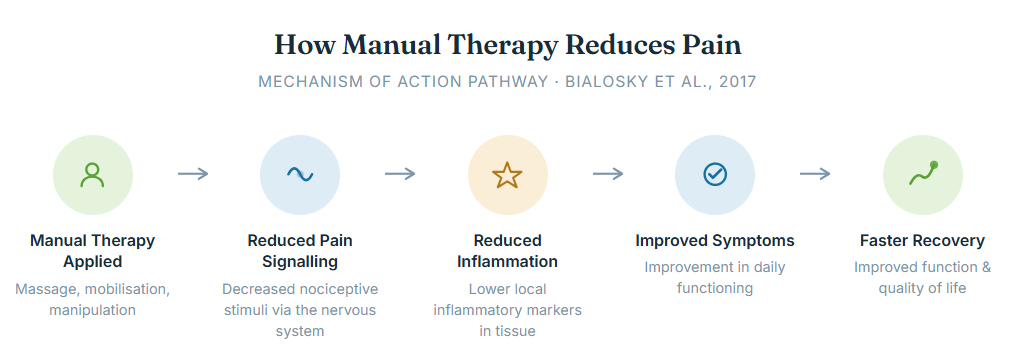
What your physio just did is use manual therapy — this includes sports massage, mobilizations, and manipulations. These techniques are still being actively researched. However, it's widely accepted that the way they work is by reducing pain signaling, which in turn produces measurable improvements in range of motion and symptom presentation post-treatment (Bialosky et al., 2017). When applied locally, soft tissue techniques have been shown to reduce inflammatory markers and accelerate recovery in both post-exercise and chronic pain populations (Bialosky et al., 2017). So while it feels like your physio just helped you move your ankle by pushing it into place, what actually happened is your body changed its perception of that area — and now you have better movement.
So should you just stay home and take a paracetamol?
Well, does that mean you're probably better off staying home, taking a paracetamol and waiting out the pain? Probably not. While the effect of manual therapy is believed to be down to pain modulation, there's evidence that manual therapy in combination with exercise produces better results than pharmacological intervention with NSAIDs alone (Aleid et al., 2026). Moreover, a growing body of evidence supports manual therapy as a core component of a holistic approach to recovery — especially for instances of neck pain and ankle sprains (Aleid et al., 2026; D'Hooghe, Cruz and Alkhelaifi, 2020). Sports massage, similarly, demonstrates benefit in the management of lower back pain (Laferriere, Mondelli and Rivera, 2026), while broader manual therapy and spinal manipulation approaches have been shown to improve both symptoms and quality of life in chronic lower back pain populations (Aoyagi et al., 2019; Coulter et al., 2018; Rubinstein et al., 2019).
So is manual therapy magic? (No.)
So while a lot of physiotherapists choose to use manual therapy as part of their management program, it's not magic. Manual therapy is just part of the puzzle — it's not the answer to all your problems. So don't be confused if your physiotherapist doesn't do any hands-on work with you; remember that manual therapy is an adjunct, and it can help you recover faster… or maybe not.
Booked in for a sports massage in Cork? Grab a slot at TandemBalance.
Stay Nerdy!
Mariam Aziz, Chartered Physiotherapist
References:
Aleid, A. M., Alyabis, N. A., Aldanyowi, S. N., Alsubaie, M. N., AlOraini, L. I., Almoslem, A. R., Albinsaad, L. S., AlAidarous, H. A., Aleid, Z. M. and Mutair, A. A. (2026) 'Evaluation of cervical pain interventions: Systematic review and meta-analysis of physical therapy, exercise, and medications', Electronic Journal of General Medicine, 23(1), pp. 1-11. https://doi.org/10.29333/ejgm/17916
Aoyagi, K., He, J., Nicol, A. L., Clauw, D. J., Kluding, P. M., Jernigan, S. and Sharma, N. K. (2019) 'A Subgroup of Chronic Low Back Pain Patients With Central Sensitization', The Clinical Journal of Pain, 35(11). https://doi.org/10.1097/AJP.0000000000000755
Bialosky, J. E., Beneciuk, J. M., Bishop, M. D., Coronado, R. A., Penza, C. W., Simon, C. B. and George, S. Z. (2017) 'Unraveling the Mechanisms of Manual Therapy: Modeling an Approach', Journal of Orthopaedic & Sports Physical Therapy, 48(1), pp. 8-18. https://doi.org/10.2519/jospt.2018.7476
D’Hooghe, P., Cruz, F. and Alkhelaifi, K. (2020) 'Return to Play After a Lateral Ligament Ankle Sprain', Current Reviews in Musculoskeletal Medicine, 13(3), pp. 281-288. Available at: https://doi.org/10.1007/s12178-020-09631-1
Coulter, I. D., Crawford, C., Hurwitz, E. L., Vernon, H., Khorsan, R., Suttorp Booth, M. and Herman, P. M. (2018) 'Manipulation and mobilization for treating chronic low back pain: a systematic review and meta-analysis', The Spine Journal, 18(5), pp. 866-879. https://doi.org/10.1016/j.spinee.2018.01.013
Laferriere, Z., Mondelli, N. and Rivera, M. J. (2026) 'The Effectiveness of Muscle Energy Techniques and Joint Manipulations in Functional Improvements and Pain Reduction in Patients With Sacroiliac Joint Pain: A Critically Appraised Topic', Journal of Sport Rehabilitation, 35(1), pp. 87-92. https://doi.org/10.1123/jsr.2024-0323
Rubinstein, S. M., de Zoete, A., van Middelkoop, M., Assendelft, W. J. J., de Boer, M. R. and van Tulder, M. W. (2019) 'Benefits and harms of spinal manipulative therapy for the treatment of chronic low back pain: systematic review and meta-analysis of randomised controlled trials', BMJ, 364, pp. l689. https://doi.org/10.1136/bmj.l689
